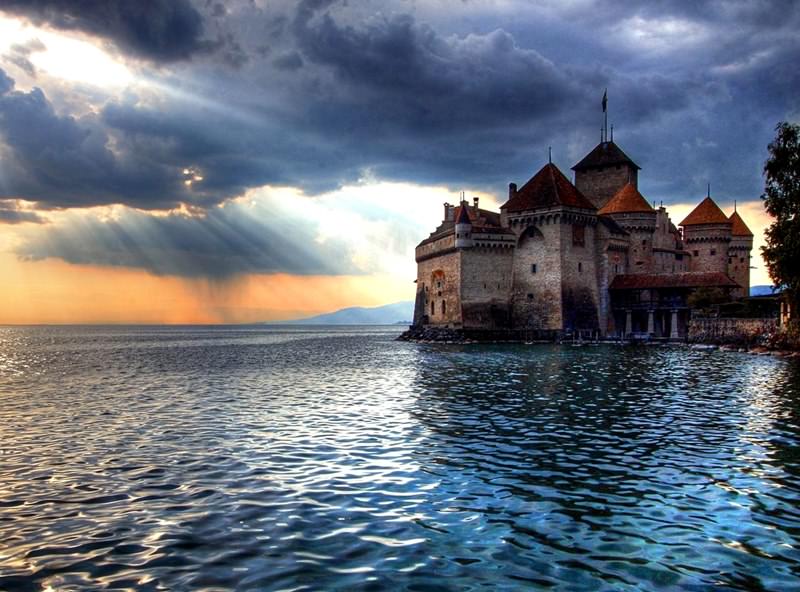

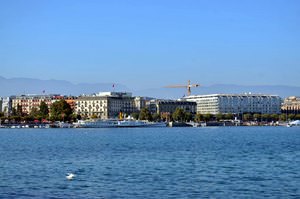
 Geneva is not too popular with tourists because the city has a reputation of a boring, sterile and over-correct city. This statement is, in fact, not true. Geneva can be proud of its prime location on the shores of Lake Geneva, narrow streets around old Bourg de Four Square
  , in which tourists can wander for hours, beautiful historic buildings and interesting museums (the brilliant Museum of Contemporary Art is one of them), lots of lovely parks , as well as nice and cozy restaurants , bars and nightclubs .
Geneva never ceases to amaze travelers by its attractions, many of which are truly unusual. For example, every day hundreds of tourists come to see wonderful flower clock located on …  Open
Open
 Open
Open
Cathedral of Saint-Pierre
is located at the highest point of the old town, at a height of 404m above the sea level. Many centuries ago, a Roman temple once stood on this place. Starting from the IV-V century, a small Christian basilica started appearing there. During the largest archaeological excavations in Europe the remains of earlier churches, the baptismal chapel of the IV century, and mosaic of the V century were discovered under the cathedral. The Cathedral of Saint-Pierre was built in 1150-1232 in the Roman style with some Gothic elements. Its capitals are made in the style of late romanticism and early Gothic.
Lovers of nightlife should move their feet to Bourg de Fours Square, as numerous nightclubs, bars and discos are located near it. Here you can find several casinos, but gamblers prefer to … Open
Open
The old part of the city has another noteworthy object - Tavel House (Maison Tavel)
, the oldest residential building in Geneva that has survived to our days. First mentions of the building appear in 1303. In 1334 the building was renovated. The beautiful structure with Gothic facade has become home to the Museum of Geneva (Musee du Vieux Geneve) . Here tourists will be able to see the relief that illustrates the way Geneva looked like in 1850, before the city wall was demolished. The relief was made in 1880 – 1896 by A. Manion in a scale of 1:250. In addition, the museum hosts the exhibition devoted to the life of Geneva inhabitants of that time.
 Place Neuve Square.
 The south-west of the Old Town is the location of New Square (Place Neuve)
, the central part of which is notable because of the equestrian monument dedicated to Swiss General Guillaume Henri Dufour (1787-1875). The author of the monument is sculptor Alfred Lanza (1879-1894). During the topographic shooting of Switzerland in 1832-1864, which was headed by Dufour, he managed to create a topographic map of the country, known as "map Dufour" (scale 1:100 '000, 25 pages). During the civil war of 1847 the general was the commander of the union army that fought against seven Catholic cantons, known as Sonderbund. In 1857, Dufour applied efforts to make Prussia reject Neunburg, which is now a part of Switzerland.
1. Local hotels, as well as the majority of restaurants and nightlife facilities are distinguished by rather high rates. Those, who wish to save, are recommended to pick a hotel near the … Open
Open
Beautiful Parc des Bastions
is the location of Reformers Wall (Mur des Reformateurs) . Many years ago Geneva became home to the head of the Protestant Reformation, John Calvin and his associates. By the way, at first Calvin was banished from the city because of his opinion that was very strict and rough. However, after his return in 1541, Geneva became the "reformist Rome”. The supporters of the ideas of Calvinism arrived in the city from different parts of Europe.
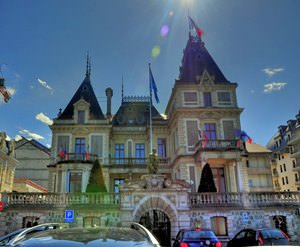 The construction of the wall was started in 1909 to celebrate the 400th anniversary of Calvin's birth and the 350th anniversary of Geneva Academy for priests, which was founded by Calvin. Travellers will see the memorial panel installed in the old defensive wall. Its central part is decorated with five-meter sculptures of famous figures of the Reformation - Guillaume Farel (1489-1565), the creator of first reformation ideas, John Calvin (1509-1564), the undisputed leader of the movement, Theodore Beza (1513-1605), the first rector of the Academy for priests, and John Knox (1513-1572), a Scottish who was the founder of the Presbyterian Church. Visitors will also see the statues of other reformers from different countries to the right and left of the main sculptures.
Unusual excursions and entertainments will help to make your stay in Geneva even more interesting and exciting. If you crave romantics and want to be closer to nature, make a walk to Lake … Open
Open
The port waters of Lake Geneva are the location of the main attraction of Geneva - Jet d'Eau fountain, which literally means "water jet" (Jet d'Eau) . Originally, the fountain was a safety hydropower valve. Today, it has become a symbol of Geneva. Previously, the water in the fountain did not rise so high, however, after the installation of a special pump in 1951, every second 500l of water rise to a height of 140m at a speed of 200 km/h. In the evening, the fountain is lit beautifully, attracting many tourists and locals.
 If you walk along Quai du General-Guisan Boulevard , which stretches along the lake, you can see another landmark of Geneva - Flower Clock (L'Horloge Fleurie), located on edge of English Garden. These watches are made from thousands of flowers. They are a kind of tribute to the watch industry of Geneva. Several times a year the floral arrangement is updated according to the current season.