

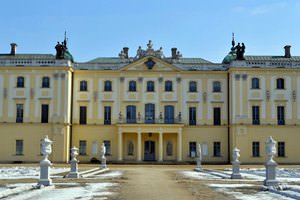
 Local people are tactful and communicative people. During holidays and celebrations, they are friendly and like talking to people they know a little. They will have fun and tell jokes, keeping the distance at the same time. Local people talk about private themes with close friends and relatives only, but when communicating with people they do not know so well they will find many interesting and pleasant themes. People in Bialystok also have quite an unusual way of talking. It feels like nothing can put them out of temper. Even in the moments of arguing, they are always very polite and keep insisting that their opinion is the right one – it is almost impossible to make them change it.
The population of this town mainly consists from Polish and Belorussian people. Bialystok is known by the large number of educational institutions as on its territory you will find 15 …  Open
Open
 Open
Open
The majority of local food is distinguished by simplicity, skillful use of different spices, and an unforgettable combination of cuisines of the world. Culinary traditions of Bialystok … Open
Open
 As one of the largest cities in Poland, Bialystok regularly hosts various interesting festivals, some of which have become internationally famous. Halfway Festival is one of these events. This is one of a kind festival that connects musicians and listeners. That is even stated in the motto of the event: “close to people, close to music”. There are no headliners as every artist is important at Halfway. There are also no serious restrictions and rules, and so visitors can talk to musicians or see them walking around. There is also no fixed schedule, so musicians can perform as long as they and audience want and don’t worry about leaving the scene for the next band.
Bialystok and its neighborhoods have much to offer to tourists. There are many unusual places of interest that attract tourists from all over the world to the city. Start your acquaintance … Open
Open
National traditions of Poland
 Dances play an important role in Polish culture. The most famous is the mazurka. In the 19th century, it became one of the main ballroom dances in the whole of Europe. There are three varieties of this dance: mazur, oberek, and kujawiak. Mazur is a classic version and the most common. The famous Polish composer Frederic Chopin wrote more than 60 different melodies for this dance. Oberek has a more complex rhythm. Kujawiak, on the other hand, is more fluid and lyrical, reminiscent of a waltz. Polish folk dance appeared among the peasants. It personifies the national art of the country. With the help of the dance, the peasants celebrated the main events of their life, including weddings and harvesting. A huge number of people participate in it simultaneously. The dance is accompanied by complex poses, which give it the special spectacularity and temperament.
… Open
Dances play an important role in Polish culture. The most famous is the mazurka. In the 19th century, it became one of the main ballroom dances in the whole of Europe. There are three varieties of this dance: mazur, oberek, and kujawiak. Mazur is a classic version and the most common. The famous Polish composer Frederic Chopin wrote more than 60 different melodies for this dance. Oberek has a more complex rhythm. Kujawiak, on the other hand, is more fluid and lyrical, reminiscent of a waltz. Polish folk dance appeared among the peasants. It personifies the national art of the country. With the help of the dance, the peasants celebrated the main events of their life, including weddings and harvesting. A huge number of people participate in it simultaneously. The dance is accompanied by complex poses, which give it the special spectacularity and temperament.
… Open